
Pour over coffee is a manual brewing method that lets you control water temperature, pouring speed, and extraction for a clean, flavorful cup at home.
What Is Pour Over Coffee?
Pour over coffee is a manual brewing method where hot water is poured over ground coffee in a filter. The water slowly passes through the grounds and drips into a cup or carafe, producing a clean cup with fewer coffee particles.
Why choose pour over coffee?
- More control: Adjust the brewing process to suit your taste.
- Clear flavor: Paper filters trap most fine particles and some coffee oils.
- Simple setup: You only need a dripper, filter, ground coffee, and hot water.
- Flexible brewing: Experiment with different beans, grind sizes, and coffee-to-water ratios.
Pour over is especially appealing to coffee drinkers who enjoy preparing their coffee by hand and exploring the flavors of different beans.
How Does Pour Over Coffee Work?
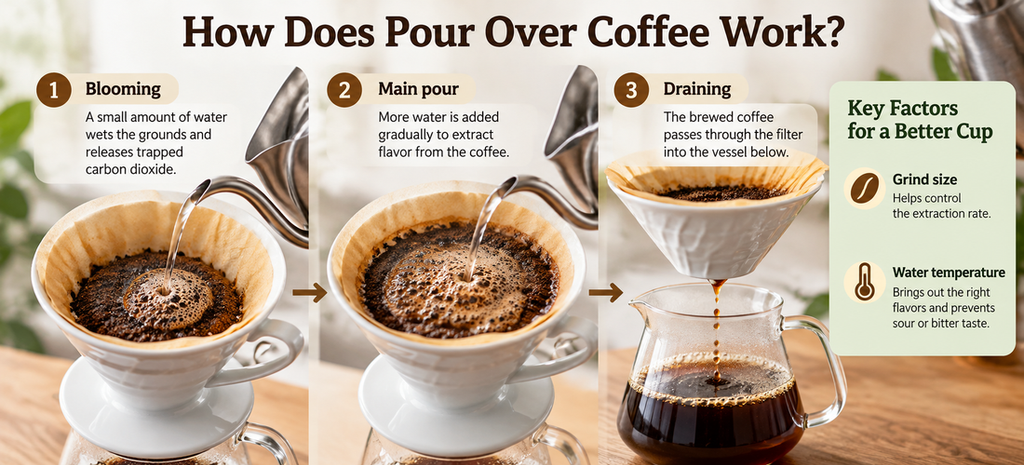
Pour over brewing relies on gravity and the interaction between hot water and ground coffee. As water passes through the grounds, it extracts soluble compounds that give coffee its aroma, sweetness, acidity, and bitterness.
The process usually includes three stages:
- Blooming: A small amount of water wets the grounds and releases trapped carbon dioxide.
- Main pour: More water is added gradually to extract flavor from the coffee.
- Draining: The brewed coffee passes through the filter into the vessel below.
Using the right grind size and water temperature also helps prevent sour or bitter flavors, making it easier to achieve a smooth, flavorful cup.
Pour Over vs. Drip Coffee: What’s the Difference?
Both methods use hot water and a filter, but the main difference is how the water is delivered. Pour over is usually manual, while an automatic drip coffee maker controls the brewing process for you.
| Feature | Pour Over | Automatic Drip Coffee |
|---|---|---|
| Brewing process | Manually controlled | Machine-controlled |
| Flavor adjustment | High level of control | Depends on the machine |
| Equipment | Dripper, filter, kettle | Coffee maker and filter |
| Convenience | Requires active brewing | Mostly hands-off |
| Best for | Experimenting with flavor | Everyday convenience |
Neither method is automatically better. Pour over suits people who enjoy controlling each step, while automatic drip coffee is useful for brewing with less effort.
Essential Equipment for Pour Over Coffee
You don’t need an expensive setup to make great pour over coffee. A few basic tools help you control the brewing process, improve consistency, and bring out the best flavors in your beans.
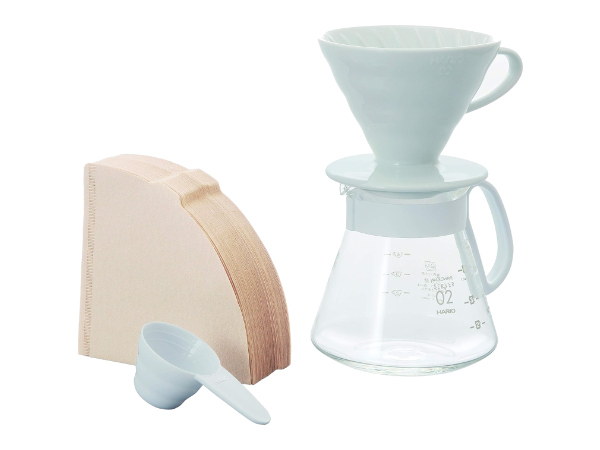
- Pour Over Dripper: Holds the filter and coffee grounds.
- Coffee Filters: Paper filters create a cleaner cup; metal filters preserve more oils.
- Gooseneck Kettle: Provides better control over water flow.
- Digital Scale: Measures coffee and water accurately.
- Coffee Grinder: A burr grinder delivers a more consistent grind.
- Timer: Tracks blooming and total brewing time.
A digital scale and gooseneck kettle are worthwhile additions because they make it easier to control each brew and achieve consistent results.
Choosing the Right Coffee Beans and Grind Size
Freshly roasted beans can make a noticeable difference in pour over coffee. Light and medium roasts are popular because they often showcase the beans’ natural flavor characteristics, although darker roasts can also work well.
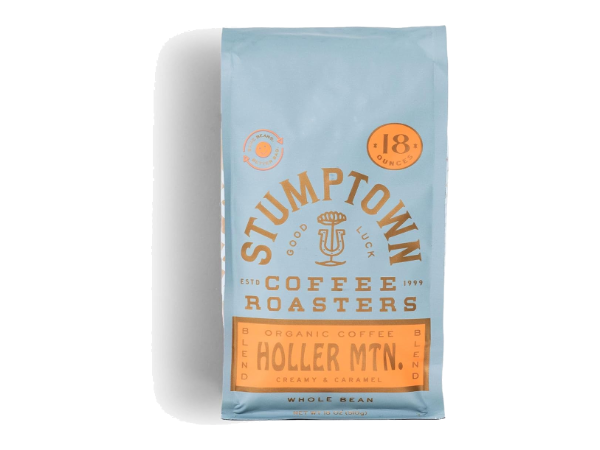
For a versatile everyday option, try Stumptown Holler Mountain Whole Bean Coffee, a medium roast with citrus, caramel, and hazelnut notes.
Use these adjustments as a guide:
- Coffee tastes sour or weak: Try grinding a little finer or extending the brewing time.
- Coffee tastes bitter or harsh: Try grinding a little coarser or shortening the brewing time.
- Water drains too quickly: A finer grind may help slow the flow.
- Water drains too slowly: A coarser grind may improve it.
A medium to medium-fine grind is a good starting point for many pour over brewers, but the ideal setting depends on the dripper, filter, and recipe.
What Is the Best Coffee-to-Water Ratio for Pour Over?
A good starting point is a 1:16 coffee-to-water ratio. This means using 1 gram of coffee for every 16 grams of water. You can adjust the ratio to make the brew stronger or lighter.
| Coffee | Water | Approximate Serving |
|---|---|---|
| 15 g | 240 g | One small cup |
| 20 g | 320 g | One large cup |
| 30 g | 480 g | Two cups |
For a stronger brew, try a 1:15 ratio. For a lighter cup, start with 1:17. These are starting points rather than strict rules, so adjust them to suit your beans and taste.
How to Make Pour Over Coffee Step by Step
Follow this simple recipe to brew a balanced cup of pour over coffee. It works as a starting point for most popular drippers.
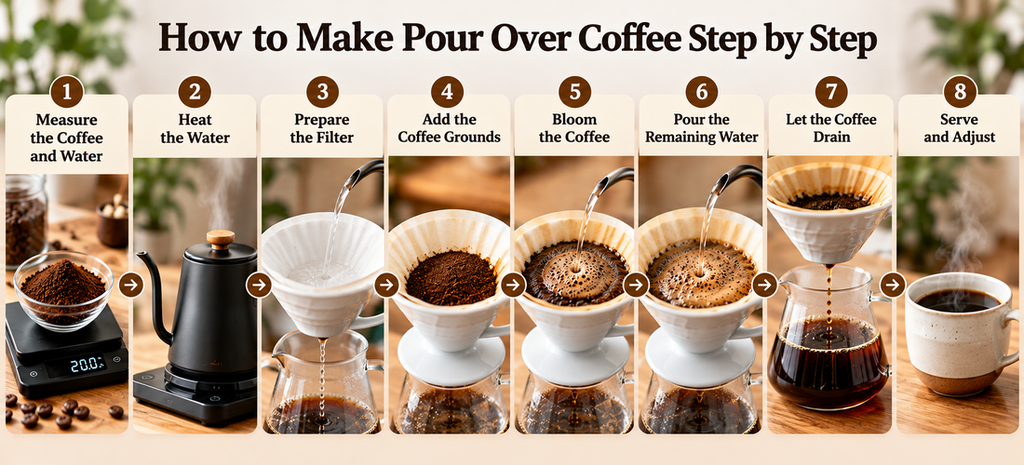
Step 1: Measure the Coffee and Water
Use 20 g of ground coffee and 320 g of water for a 1:16 coffee-to-water ratio.
Step 2: Heat the Water
Heat water to 195–205°F (90–96°C). Slightly lower temperatures may work better for darker roasts.
Step 3: Prepare the Filter
Place the filter in your dripper and rinse it with hot water to remove paper taste and warm the brewing equipment. Discard the rinse water.
Step 4: Add the Coffee Grounds
Grind your beans to a medium or medium-fine consistency. Add the grounds to the filter and level the coffee bed.
Step 5: Bloom the Coffee
Pour 40–60 g of water evenly over the grounds. Let the coffee bloom for 30–45 seconds to release trapped carbon dioxide.
Step 6: Pour the Remaining Water
Slowly add the remaining water in steady, circular pours. Avoid pouring directly onto the filter walls.
Step 7: Let the Coffee Drain
Allow the water to pass through the grounds completely. Aim for a total brewing time of around 2.5–4 minutes, adjusting as needed for your dripper and grind size.
Step 8: Serve and Adjust
Swirl the brewed coffee gently and taste it. If it tastes sour, try a finer grind; if it tastes bitter, try a coarser grind on your next brew.
Which Pour Over Method Is Best: Hario V60, Chemex or Kalita Wave?
The best brewer depends on your preferred flavor, filter style, and brewing routine. These three options are popular, but each has a different design.
| Brewer | Main Characteristics | Best For |
|---|---|---|
| Hario V60 | Cone shape and spiral ribs support adjustable flow | People who enjoy experimenting with pouring and extraction |
| Chemex | Thick paper filters help produce a clean, light-bodied cup | Those who prefer clarity and a simple carafe-style design |
| Kalita Wave | Flat bottom and multiple drainage holes encourage an even flow | Beginners seeking a forgiving, consistent brewing routine |
The Hario V60 offers flexibility but can respond noticeably to pouring technique. Chemex is a good choice for clean-tasting coffee and larger batches, while Kalita Wave is often appreciated for its straightforward brewing process.
Common Pour Over Coffee Mistakes and How to Fix Them
Even small changes can improve pour over coffee. Use this table to identify common problems and practical solutions.
| Problem | Possible Cause | How to Fix It |
|---|---|---|
| Sour or underdeveloped taste | Grind is too coarse or extraction is too short | Grind slightly finer or increase contact time |
| Bitter or harsh flavor | Grind is too fine or extraction is excessive | Grind slightly coarser or reduce contact time |
| Weak, watery coffee | Too little coffee or too much water | Adjust the coffee-to-water ratio |
| Uneven flavor | Grounds are not evenly wetted | Pour steadily across the coffee bed |
| Brewing takes too long | Grind is too fine or the filter is clogged | Try a coarser grind and check the filter |
| Inconsistent results | Measurements or pouring vary | Use a scale and repeat the same recipe |
Start with a reliable ratio, an appropriate grind, and controlled pouring. Once those basics are in place, small adjustments can help you find the flavor profile you enjoy most.