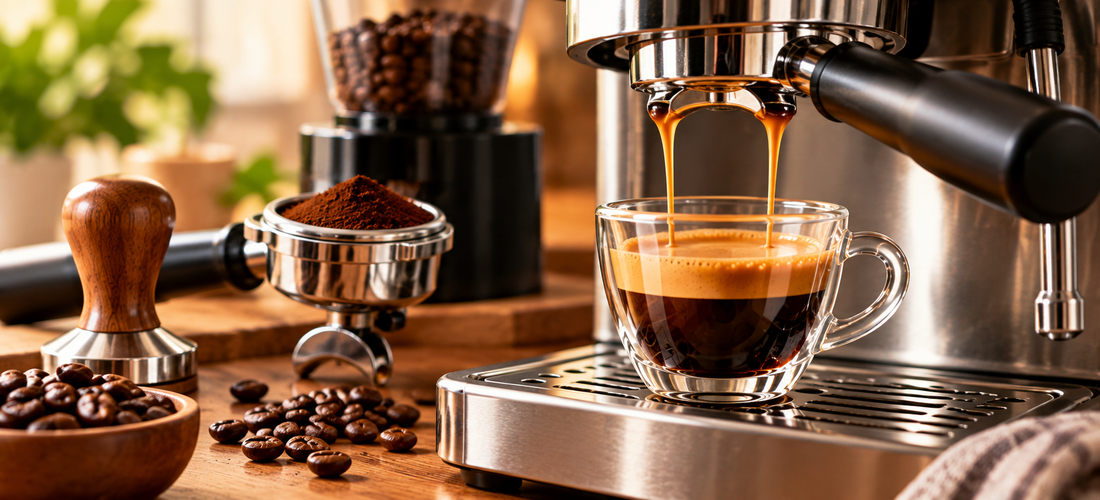
Making barista-style espresso at home is mostly about consistency. Fresh coffee, the right grind, an accurate dose, and controlled extraction can make a noticeable difference.
What Is Espresso?
Espresso is a concentrated coffee brewed by pushing hot water through finely ground coffee under pressure. It produces a small, intense shot with a rich aroma and, when properly extracted, a layer of golden crema.
A good espresso typically has:
- Rich aroma and concentrated coffee flavor
- Balanced sweetness, acidity, and bitterness
- Full body with a smooth mouthfeel
- Crema on the surface of a freshly brewed shot
Unlike drip coffee, the water passes through a compact coffee puck under pressure, which helps extract a wide range of flavors.
What You Need to Make Espresso at Home
Making good espresso at home does not require a large collection of professional equipment. A few basic tools are enough to prepare a consistent shot and make small adjustments to the brewing process.
| Equipment | Purpose |
|---|---|
| Espresso machine | Brews coffee under pressure |
| Burr grinder | Produces a consistent espresso grind |
| Espresso beans | Fresh coffee for brewing |
| Portafilter | Holds the ground coffee |
| Tamper | Compresses the coffee evenly |
| Digital scale | Measures coffee and espresso output |
| Espresso cup | Holds the finished shot |
A burr grinder is particularly useful because small changes in grind size can significantly affect extraction.
Best Coffee Beans for Espresso
There is no single coffee bean that is perfect for every espresso drink. Medium and medium-dark roasts are popular because they often produce a full body and flavors that work well with milk.

You also do not necessarily need coffee labeled “espresso roast.” Many quality coffee beans can be brewed successfully as espresso when the grind and recipe are adjusted correctly.
Choosing the Right Grind Size for Espresso
Espresso generally requires a fine grind, but the exact setting depends on the coffee, grinder, machine, and dose.
If the espresso flows too quickly and tastes thin or sour, the grind may be too coarse. If the shot takes too long and tastes harsh or bitter, the grind may be too fine.
Tip: Dial in the grind using extraction time and taste together. Time gives you a useful reference, but flavor ultimately determines whether the shot is balanced.
How to Make Espresso at Home Step by Step
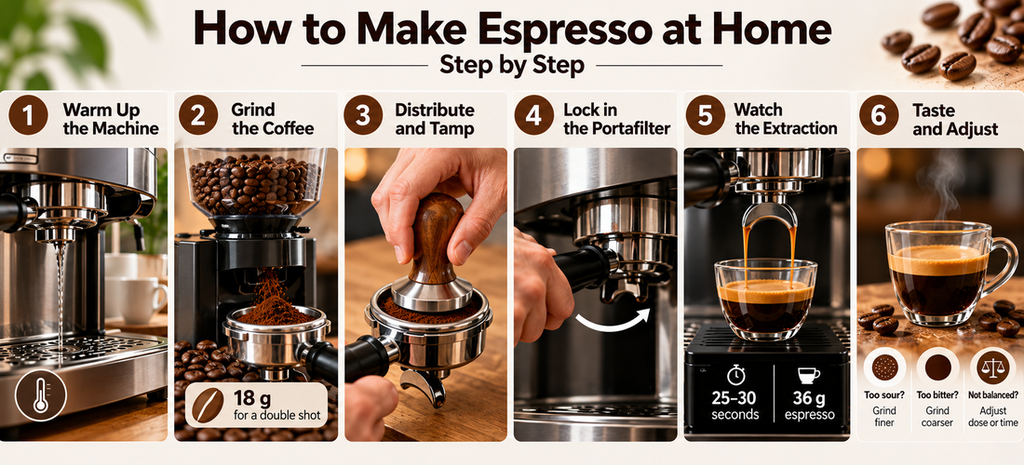
Once your equipment is ready, the process is straightforward. The key is to keep the coffee dose, grind, tamping, and extraction as consistent as possible.
1. Warm Up the Machine
Allow the espresso machine to reach its proper brewing temperature. Run a little water through the group head if recommended by your machine.
2. Grind the Coffee
Grind your beans immediately before brewing. Start with around 18 grams of coffee for a double shot and adjust according to your basket and preferred recipe.
3. Distribute and Tamp
Place the grounds evenly in the portafilter. Gently distribute them and tamp with consistent pressure.
The goal is a level, compact coffee puck. Uneven tamping can encourage channeling, where water finds weak paths through the coffee.
4. Lock in the Portafilter
Insert the portafilter into the group head and begin brewing immediately.
5. Watch the Extraction
Place your cup on a scale and monitor both the time and espresso output. A common starting point is approximately 36 grams of espresso from 18 grams of ground coffee.
6. Taste and Adjust
Taste the espresso once it has cooled slightly. If it tastes sour, bitter, weak, or overly harsh, adjust the grind or recipe and try again.
How Much Coffee Do You Need for Espresso?
The amount depends on the basket size and the style of espresso you want to make. A 1:2 coffee-to-espresso ratio is a useful starting point.
| Espresso | Ground coffee | Espresso output |
|---|---|---|
| Single shot | 7–10 g | 14–20 g |
| Double shot | 16–20 g | 32–40 g |
| Larger double | 20–22 g | 40–44 g |
For a typical home setup, 18 g of coffee → about 36 g of espresso is a practical starting recipe.
How Long Should You Extract Espresso?
A common starting point is about 25–30 seconds for a double espresso, measured from the beginning of brewing.
However, extraction time should not be treated as an absolute rule. Different beans and recipes can produce excellent results outside this range.
| Result | Possible adjustment |
|---|---|
| Very fast, sour shot | Grind finer |
| Very slow, bitter shot | Grind coarser |
| Weak flavor | Check dose and grind |
| Uneven flow | Improve distribution and tamping |
Use the time as a guide, then let the flavor of the espresso determine your final adjustment.
How to Get Better Espresso Crema
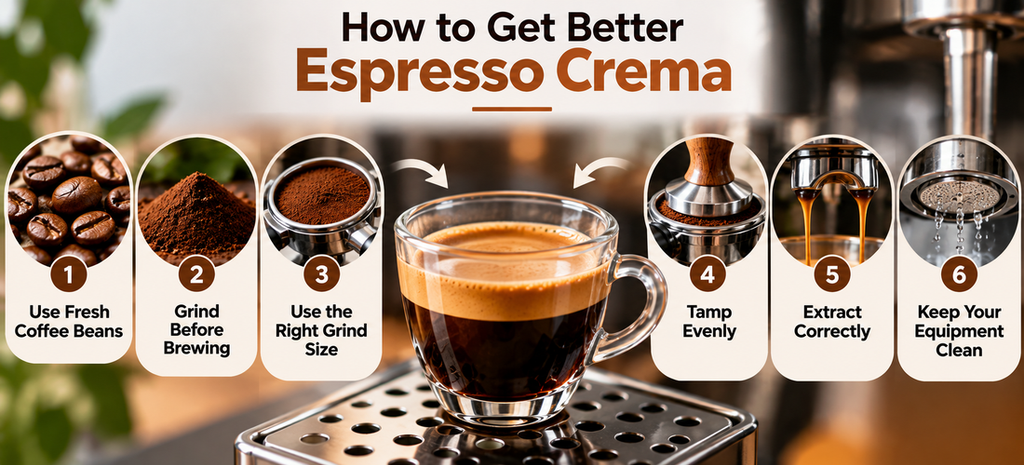
Crema is the golden-brown layer that forms on top of freshly extracted espresso. Fresh beans, proper extraction, and suitable pressure all contribute to its appearance.
For better crema:
- Use relatively fresh coffee beans.
- Grind immediately before brewing.
- Use an appropriate espresso grind.
- Tamp evenly.
- Avoid letting the coffee sit in the portafilter before brewing.
- Keep the machine and portafilter clean.
A thick layer of crema does not automatically mean the espresso tastes better. Flavor, balance, and aroma are more important than crema alone.
Common Espresso-Making Mistakes
Problems with the grind, coffee dose, tamping, or extraction can quickly change the flavor and texture of the drink. Fortunately, most common espresso mistakes are easy to identify and correct.
Using stale beans: Older coffee can produce flat and less aromatic espresso.
Grinding too coarse: Water passes through too easily, often producing a weak or sour shot.
Grinding too fine: The extraction can become slow and overly bitter.
Uneven distribution: Water may create channels through the puck instead of extracting the coffee evenly.
Inconsistent dosing: Changing the amount of coffee makes it harder to reproduce a good shot.
Ignoring the scale: Measuring only by volume makes it difficult to control the recipe consistently.
Not cleaning the machine: Coffee oils and residue can affect flavor over time.
The best way to improve is to change one variable at a time. This makes it easier to understand what actually improved the shot.
How Much Caffeine Is in Espresso?
A typical 1-ounce espresso shot contains roughly 60–75 mg of caffeine, although the actual amount can vary considerably.
Caffeine levels depend on the coffee bean, roast, dose, brewing method, and extraction.
A double espresso may therefore contain around 120–150 mg of caffeine, but it is better to treat these numbers as estimates rather than fixed values.
The amount of caffeine is determined mainly by the coffee used and the dose—not simply by how dark the espresso looks.
Espresso Recipe
Make barista-style espresso at home with freshly ground coffee, a balanced dose, and controlled extraction.
Ingredients
- 18 g freshly roasted espresso coffee beans
- Water for brewing
Instructions
- Warm up the machine. Allow the espresso machine to reach its proper brewing temperature.
- Grind the coffee. Grind 18 g of coffee immediately before brewing. Use a fine grind suitable for espresso.
- Distribute and tamp. Place the grounds evenly in the portafilter and tamp them into a level, compact puck.
- Lock in the portafilter. Insert the portafilter into the group head and begin brewing immediately.
- Extract the espresso. Aim for about 36 g of espresso from 18 g of ground coffee in approximately 25–30 seconds.
- Taste and adjust. Taste the espresso and adjust the grind or recipe if the shot tastes too sour, bitter, weak, or harsh.