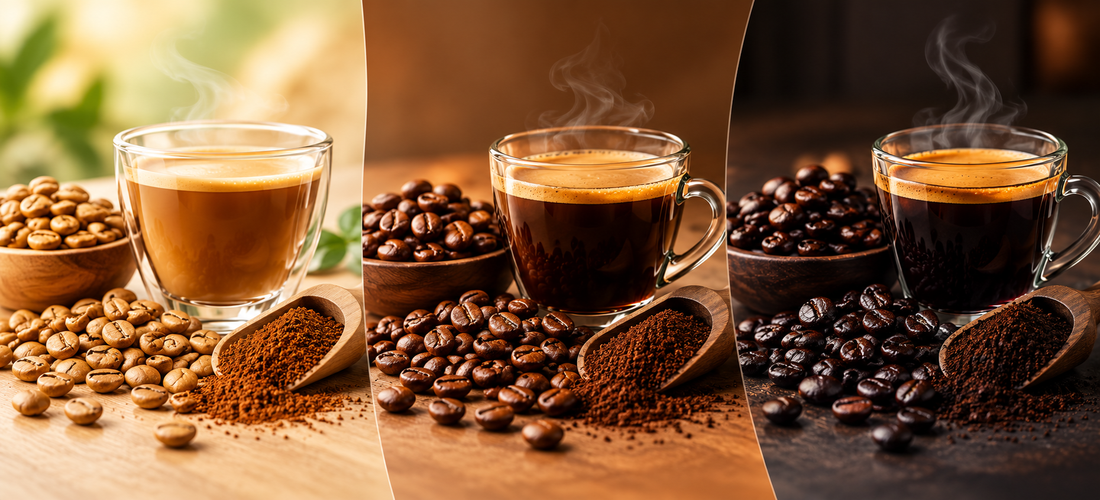
Coffee beans can start with the same green origin but taste completely different after roasting. The roast level affects flavor, aroma, acidity, body, and even how the coffee works with different brewing methods.
What Are Light, Medium & Dark Roast Coffee?
Roast level describes how long and how intensely coffee beans are roasted. As roasting continues, the beans become darker, less dense, and develop different flavor characteristics.
- Light roast: Bright, fruity, floral, and more acidic.
- Light-medium roast: Smooth, aromatic, and slightly sweet.
- Medium roast: Balanced, smooth, sweet, and moderately acidic.
- Medium-dark roast: Richer, fuller, and less acidic.
- Dark roast: Bold, rich, smoky, and less acidic.
The exact taste also depends on the coffee’s origin, processing method, and variety, so roast level is only one part of the equation.
Light vs. Medium vs. Dark Roast: Key Differences
Light, medium, and dark roasts can differ noticeably in flavor, acidity, body, and aroma. While the beans may come from the same coffee variety, the roasting process changes how their natural characteristics come through in the cup.
Light Roast
- Flavor: Fruity, floral, citrus
- Acidity: Higher
- Body: Light
- Roasted notes: Subtle
- Best for: Pour-over
Medium Roast
- Flavor: Sweet, nutty, chocolate
- Acidity: Moderate
- Body: Medium
- Roasted notes: Balanced
- Best for: Drip coffee
Dark Roast
- Flavor: Cocoa, spice, smoky
- Acidity: Lower
- Body: Full
- Roasted notes: Strong
- Best for: Espresso & French press
These are general characteristics rather than strict rules. Two coffees with the same roast level can still taste very different.
How Coffee Roast Levels Change Flavor
The longer coffee beans are roasted, the more their flavor profile changes. Natural characteristics become less prominent, while caramelized and roasted flavors become stronger.
Light Roast
Bright and lively, with fruity, floral, citrus, or berry notes. The coffee’s origin is usually easier to recognize.
Medium Roast
A middle ground between origin and roasting. Expect sweetness, moderate acidity, and flavors such as chocolate, caramel, and nuts.
Dark Roast
Roasting takes the lead, creating bold flavors like dark chocolate, toasted nuts, spice, and smoke.
The key difference is how much of the original coffee character versus roasted flavor comes through in the cup.
Which Coffee Roast Has the Most Caffeine?
If caffeine is your priority, light roast coffee is usually the best choice when beans are measured by volume, but the difference becomes much smaller when coffee is measured by weight.
A typical 8 fl oz (240 ml) cup of brewed coffee contains about 95 mg of caffeine, although real-world amounts can vary considerably. USDA research found approximately 49.7–113.8 mg of caffeine per cup in analyzed coffee samples.
Caffeine Comparison:
- Light roast: About 90–100 mg per 8 oz cup
- Medium roast: About 90–100 mg per 8 oz cup
- Dark roast: About 85–95 mg per 8 oz cup
The actual amount can be higher or lower depending on the beans, coffee-to-water ratio, grind size, and brewing method.
Why Can Light Roast Have More Caffeine?
Light-roasted beans are denser than dark-roasted beans, so a scoop may contain slightly more caffeine. When measured by weight, however, the caffeine difference between roast levels is much smaller.
Bottom line: If you want the most predictable caffeine intake, focus on the amount of coffee used and the serving size, rather than choosing a roast based on color alone.
Light Roast vs. Medium Roast vs. Dark Roast: Acidity & Body
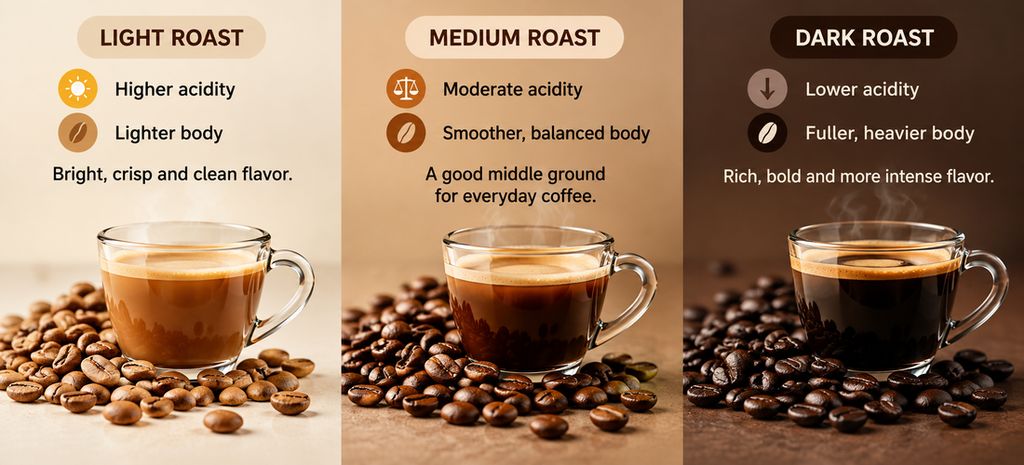
Roast level affects two noticeable parts of coffee: acidity and body. Acidity gives coffee a bright, lively quality, while body describes how heavy or rich the coffee feels in your mouth.
- Light roast: Higher perceived acidity and a lighter, cleaner body. Often feels bright and crisp.
- Medium roast: Moderate acidity with a smoother, more balanced body. A good middle ground for everyday coffee.
- Dark roast: Lower perceived acidity and a fuller, heavier body. Often feels rich, bold, and more intense.
Light roast offers the brightest acidity, medium roast provides balance, and dark roast delivers the fullest body with lower perceived acidity.
Which Roast Has More Acidity?
In general, light roasts have the highest perceived acidity, while dark roasts tend to have the lowest. Medium roast falls between the two.
Which Roast Has the Most Body?
Dark roast usually has the fullest body, followed by medium roast, while light roast tends to feel lighter and cleaner.
How to Choose the Right Coffee Roast for Your Taste
There is no universally “best” coffee roast. The right choice depends on the flavors, acidity, and body you prefer in your cup. Think about whether you enjoy bright and fruity coffee, a smooth balanced flavor, or something bold and rich.
Choose light roast if you:
- Like fruity, floral, or citrus flavors
- Prefer noticeable acidity
- Want to explore coffee origin characteristics
Choose medium roast if you:
- Want a balanced everyday coffee
- Enjoy chocolate, caramel, or nutty flavors
- Use several different brewing methods
Choose dark roast if you:
- Prefer bold and intense flavors
- Enjoy smoky or bittersweet notes
- Like a heavier-bodied cup
When trying a new coffee, look at the tasting notes as well as the roast level. They can give you a better idea of what the coffee will actually taste like.
Which Roast Is Best for Espresso, Drip & French Press?
The best coffee roast can depend on your brewing method. Each method extracts flavor differently, so some roast levels may work better for the taste and body you want.
Best Roast for Espresso
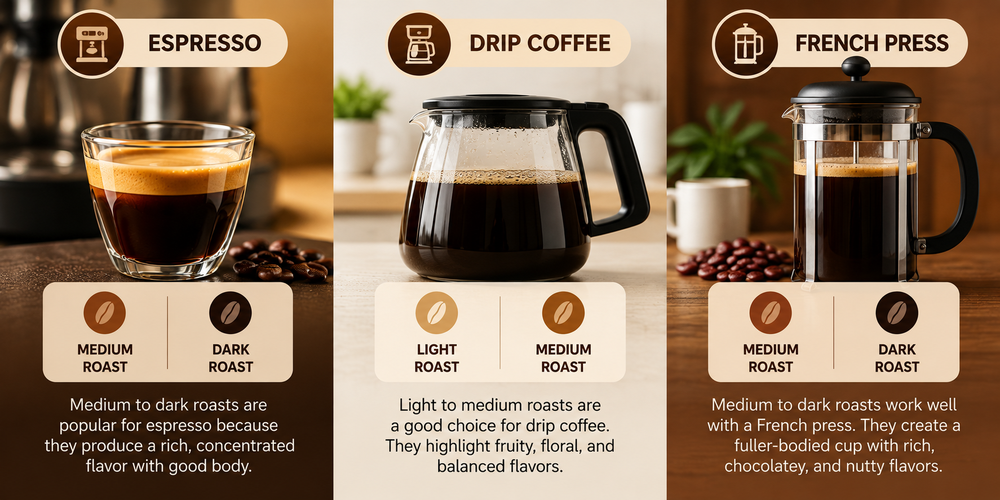
Medium and dark roasts are popular for espresso because they produce a rich body, deeper flavor, and balanced bitterness. Light roast can also work well if you prefer brighter, fruitier espresso.
Best Roast for Drip Coffee
Light and medium roasts are excellent choices for drip coffee. They can highlight fruity, floral, caramel, chocolate, and other delicate flavors without making the cup too heavy.
Best Roast for French Press
Medium and dark roasts work especially well in a French press. The immersion brewing method produces a fuller-bodied cup that pairs nicely with rich, chocolatey, nutty, and roasted flavors.
How to Brew Light, Medium & Dark Roast Coffee
The roast level affects how quickly coffee extracts, so the same brewing recipe may not produce the best result for every roast. Use the following starting points and adjust only if the coffee tastes too weak, sour, bitter, or flat.
Light Roast Coffee
For 1 cup (8 oz), start with 15 g of coffee and 240 g of water. Use water around 200–205°F (93–96°C) and a medium-fine grind. If the coffee tastes sour or too sharp, grind slightly finer or extend the brewing time.
Medium Roast Coffee
For 1 cup (8 oz), use about 15 g of coffee to 240 g of water at 195–205°F (90–96°C). A medium grind is a good starting point. If the cup tastes weak, use a slightly finer grind; if it tastes bitter, go a little coarser.
Dark Roast Coffee
Start with 15 g of coffee and 240 g of water at around 190–200°F (88–93°C). Use a medium to medium-coarse grind and avoid over-extraction. If the coffee tastes too bitter or smoky, lower the temperature or shorten the brewing time.
Light roast → hotter & longer extraction | Medium roast → standard recipe | Dark roast → slightly cooler & shorter extraction.