

Colombian coffee is known for its balanced flavor, pleasant acidity, natural sweetness, and rich aroma. From high-altitude farms to specialty roasters, Colombian beans work well for drip coffee, espresso, French press, and more.
What Is Colombian Coffee? History & Origins
Colombian coffee is coffee grown in Colombia, a country with ideal conditions for Arabica production. Coffee is believed to have reached Colombia around 1700, with commercial production expanding during the 19th century.
Key characteristics of Colombian coffee include:
- Arabica beans: Most Colombian coffee is Arabica, with a smooth, complex flavor.
- High-altitude growing: Many farms are in mountains where cherries mature slowly.
- Small-scale farms: Much of Colombia’s coffee comes from family farms.
- Hand-picked cherries: Ripe cherries are hand-selected for consistent quality.
- Diverse flavors: Colombian beans offer chocolate, caramel, nutty, citrus, berry, or stone-fruit notes.
This diversity is one reason Colombian coffee works well across different brewing methods, from pour-over and drip coffee to espresso.
Best Colombian Coffee Beans: Top Picks
The best Colombian coffee depends on how you like to brew and what flavors you prefer. Rather than choosing beans only by brand, look for information about origin, roast date, variety, processing method, and elevation.
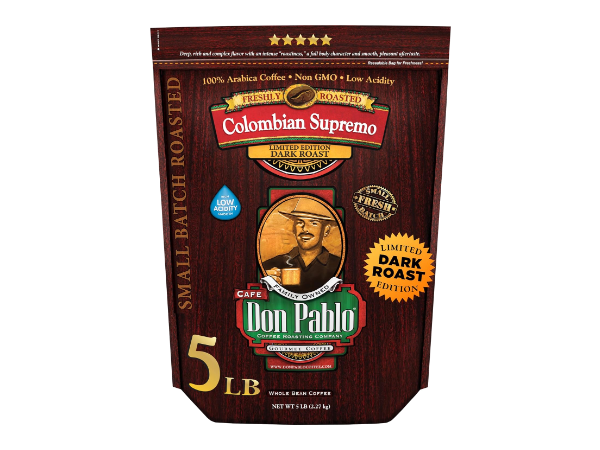
Don Pablo Colombian Supremo – Whole Bean Coffee
Don Pablo Colombian Supremo is a 100% Arabica coffee grown in the Colombian Andes and roasted to a medium-dark level. It is designed for a smooth, sweet cup with moderate body rather than a sharp or highly acidic profile.
Key features:
- Origin: Colombian Andes
- Bean type: 100% Arabica
- Roast: Medium-dark
- Acidity: Low
- Flavor: Chocolate, cocoa, walnut, citrus
- Body: Medium with a smooth finish
The low-acid profile makes Don Pablo Colombian Supremo particularly interesting for drinkers who prefer a softer cup.
Amazon Fresh Colombia Whole Bean Coffee
The beans are 100% Arabica grown in Colombia and come in a medium roast that aims for a balanced, full-bodied cup without the heavier roast character of dark coffee.
Key features:
- Origin: Colombia
- Bean type: 100% Arabica
- Roast: Medium
- Format: Whole beans
- Size: 32 oz
- Flavor: Balanced, smooth, full-bodied
This coffee is a practical choice when you want a familiar Colombian profile without paying for a specialty micro-lot.

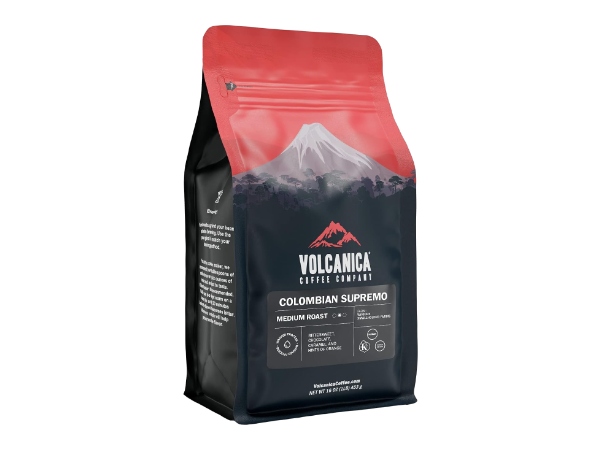
Volcanica Coffee Colombian Supremo Whole Bean
Volcanica Colombian Supremo comes from the Colombian Andes, with the current product information identifying Santander as the region and describing the beans as a medium-roast, washed-process coffee.
Key features:
- Origin: Santander, Colombia
- Bean type: Colombian Arabica
- Roast: Medium
- Process: Washed
- Flavor: Chocolate, caramel, orange
- Body: Medium to full
The combination of sweetness, controlled acidity, and pronounced body makes Volcanica Colombian Supremo versatile for drip coffee, pour-over, French press, and espresso.
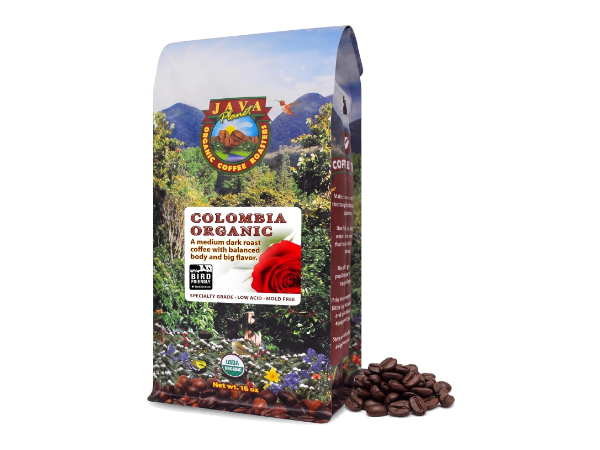
Java Planet Low Acid Organic Colombian Whole Bean Coffee
Java Planet Colombia Organic is a medium-dark Colombian coffee aimed at drinkers who want a rich cup with lower acidity. The beans are USDA Organic and specialty-grade Arabica, and the company describes them as naturally low in acid.
Key features:
- Origin: Colombia
- Bean type: Specialty-grade Arabica
- Roast: Medium-dark
- Acidity: Naturally low
- Certification: USDA Organic
- Format: Whole bean, 1 lb
The company also says its Colombian beans are third-party tested for mold, mycotoxins, and heavy metals, while roast dates are printed on the bags for freshness tracking.
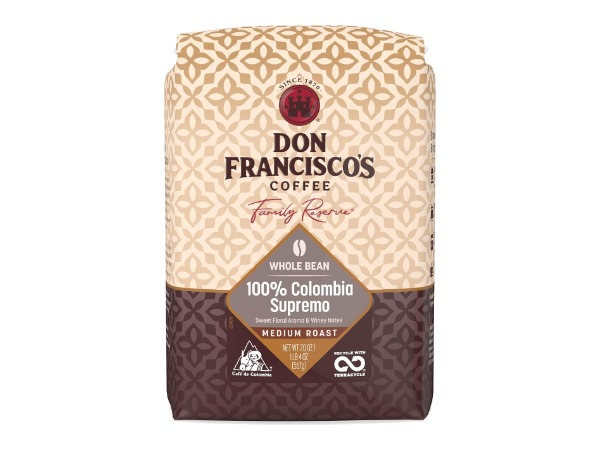
Don Francisco’s 100% Colombia Supremo Whole Bean
Don Francisco’s 100% Colombia Supremo is a single-origin Colombian Arabica coffee with a medium roast designed to keep the cup mild, sweet, and balanced.
Key features:
- Origin: Colombia, South America
- Bean type: 100% Arabica
- Roast: Medium
- Type: Single origin
- Flavor: Floral, wine-like, sweet
- Body: Medium
It can work particularly well for breakfast brewing, drip machines, pour-over, or French press when you want Colombian flavor with noticeable sweetness but without an aggressive roast taste.
Where Is Colombian Coffee Grown? Major Coffee Regions
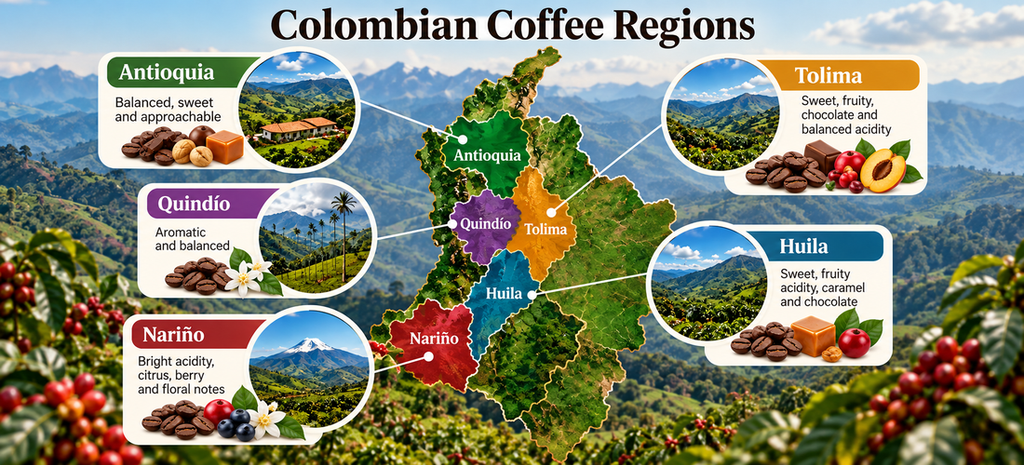
Colombian coffee is grown mainly in the mountainous regions of the Andes, where elevation, climate, soil, and rainfall create different growing conditions. As a result, coffee from one region can taste noticeably different from coffee grown elsewhere in Colombia.
Huila
Huila is one of Colombia’s most recognized coffee regions. Beans from the area often have pronounced sweetness, fruity acidity, and notes of caramel or chocolate.
Antioquia
Antioquia has a long coffee-growing tradition. Coffees from this region are often described as balanced, sweet, and approachable, making them suitable for everyday brewing.
Quindío
Located in the famous Coffee Cultural Landscape, Quindío produces coffees with aromatic and balanced profiles. The region is also closely connected with Colombia’s coffee tourism.
Nariño
High elevations in Nariño can contribute to bright acidity and complex flavors. These coffees may show citrus, berry, floral, or wine-like characteristics.
Tolima
Tolima produces a wide range of specialty coffees. Depending on the farm and processing method, beans can offer combinations of sweetness, fruitiness, chocolate, and balanced acidity.
Colombian Coffee Varieties: Caturra, Castillo & More
Colombian coffee farms grow several Arabica varieties. Caturra and Castillo are among the varieties commonly associated with Colombian production.
| Variety | General characteristics |
|---|---|
| Caturra | Balanced cup, good sweetness and acidity |
| Castillo | Adaptable variety with diverse flavor potential |
| Colombia | Developed for Colombian growing conditions |
| Typica | Traditional Arabica variety with a clean, classic profile |
| Bourbon | Often associated with sweetness and complexity |
The final flavor is not determined by variety alone. Elevation, soil, climate, harvesting, processing, and roasting all influence the finished cup.
5 Reasons Colombian Coffee Beans Work So Well for Espresso
Colombian beans can be an excellent choice for espresso, particularly when you want a shot with sweetness and balanced acidity rather than only intense bitterness.
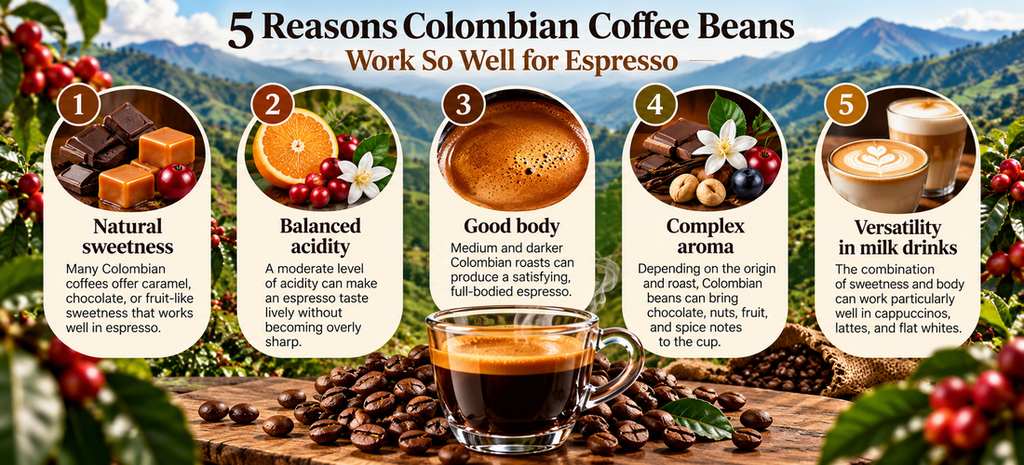
1. Natural sweetness
Many Colombian coffees offer caramel, chocolate, or fruit-like sweetness that works well in espresso.
2. Balanced acidity
A moderate level of acidity can make an espresso taste lively without becoming overly sharp.
3. Good body
Medium and darker Colombian roasts can produce a satisfying, full-bodied espresso.
4. Complex aroma
Depending on the origin and roast, Colombian beans can bring chocolate, nuts, fruit, and spice notes to the cup.
5. Versatility in milk drinks
The combination of sweetness and body can work particularly well in cappuccinos, lattes, and flat whites.
For espresso, a medium to medium-dark Colombian roast is a practical starting point, although lighter specialty roasts can also produce excellent results.
Is Colombian Coffee Strong? Flavor, Caffeine & Strength Explained
Colombian coffee can taste strong, but that does not necessarily mean it contains more caffeine. A typical 8-oz (240 ml) cup of brewed Colombian coffee may provide around 80–120 mg of caffeine, although the actual amount varies by beans and brewing method.
The word “strong” can refer to several different things:
- Flavor strength — how intense the coffee tastes.
- Body — how heavy or rich it feels in the mouth.
- Roast intensity — how developed or dark the roast is.
- Caffeine content — the actual amount of caffeine in the serving.
These factors can make Colombian coffee feel stronger or milder, but caffeine is the easiest way to compare its stimulating effect. The table below gives typical caffeine amounts for common serving sizes.
| Serving | Approx. caffeine |
|---|---|
| 8 oz brewed Colombian coffee | 80–120 mg |
| 12 oz brewed coffee | 120–180 mg |
| 1 oz espresso | ~60–70 mg |
Colombian coffee is usually Arabica, which generally contains less caffeine than Robusta. However, the final caffeine content depends on the bean, serving size, brewing method, coffee-to-water ratio, and extraction time.
Colombian vs. Arabica Coffee: What’s the Difference?
Colombian describes where the coffee was grown, while Arabica describes the species of coffee plant.
Most traditional Colombian coffee is Arabica, so a coffee can accurately be described as both Colombian and Arabica.
| Colombian | Arabica |
|---|---|
| Describes geographic origin | Describes coffee species |
| Grown in Colombia | Grown in many countries |
| Often associated with balanced, sweet profiles | Generally known for complex flavors |
| Usually Arabica | Includes beans from many origins |
For example, Colombian Arabica and Ethiopian Arabica are both Arabica coffees, but their flavors can be very different because of their growing environments and processing methods.
How to Brew Colombian Coffee Beans
he best brewing method depends on the roast, grind size, and flavor profile of the beans. Colombian coffee is versatile, so the same beans can taste very different depending on how they are brewed.
| Brewing method | Grind | Coffee-to-water ratio | Water temperature | Brewing time |
|---|---|---|---|---|
| Pour-Over | Medium-fine | 1:15–1:17 | 195–205°F (90–96°C) | 2.5–4 min |
| Drip Coffee | Medium | 1:15–1:17 | 195–205°F (90–96°C) | 4–6 min |
| Espresso | Fine | ~1:2 | 195–203°F (90–95°C) | 25–30 sec |
| French Press | Coarse | 1:15 | 195–205°F (90–96°C) | 4–5 min |
These settings are a useful starting point, but Colombian coffee can respond differently depending on the roast, freshness, and processing method.
Pour-Over
Pour-over is a good choice for light and medium Colombian roasts. A medium-fine grind and controlled pouring can bring out citrus, fruit, floral notes, and natural sweetness.
Drip Coffee
A drip coffee maker is ideal for everyday brewing. Medium Colombian roasts with chocolate, caramel, or nutty notes usually produce a balanced and easy-drinking cup.
Espresso
For espresso, use a fine grind and start with a roughly 1:2 coffee-to-yield ratio. Medium to medium-dark Colombian beans can produce espresso with good body, sweetness, and balanced acidity. Adjust the grind to control extraction time and flavor.
French Press
French press works particularly well with medium and dark Colombian roasts. Use a coarse grind and steep for about 4–5 minutes to produce a fuller-bodied cup.
Brewing tip: If your Colombian coffee tastes sour or weak, try a finer grind or slightly longer extraction. If it tastes bitter or overly dry, use a coarser grind or shorten the brewing time. Freshly ground beans and good-quality water can also make a noticeable difference.