
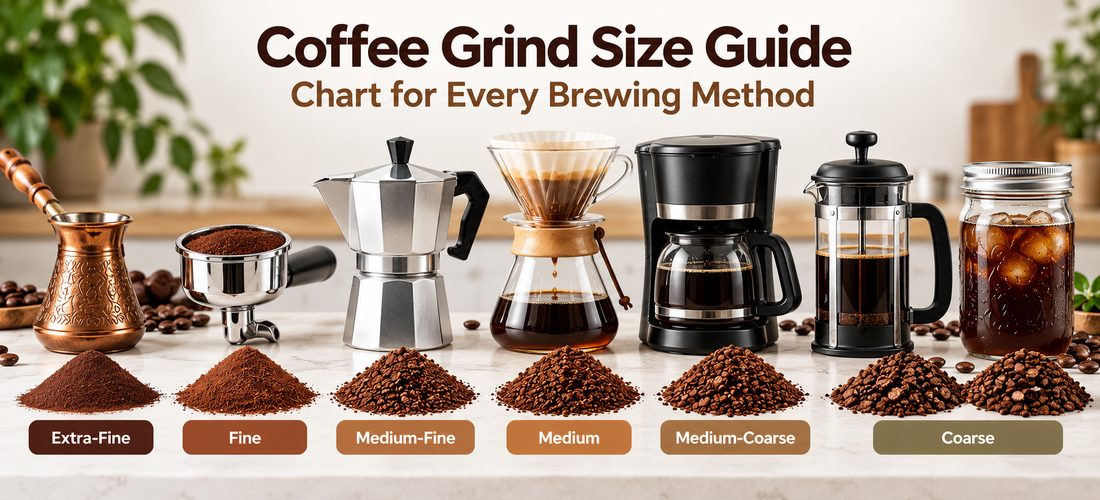
Coffee grind size has a direct effect on how quickly water extracts flavor from ground coffee. A grind that is too fine can produce a bitter, harsh cup, while a grind that is too coarse may leave coffee weak or sour.
What Is Coffee Grind Size?
Coffee grind size refers to how finely or coarsely coffee beans are ground before brewing. The main categories range from extra-fine to coarse.
| Grind Size | Typical Texture | Common Uses |
|---|---|---|
| Extra-Fine | Powder-like | Turkish coffee |
| Fine | Fine sand | Espresso |
| Medium-Fine | Fine sand | Pour over, AeroPress |
| Medium | Regular sand | Drip coffee |
| Medium-Coarse | Rough sand | Chemex, percolator |
| Coarse | Small, uneven pieces | French press, cold brew |
There is no universal grinder setting that works for every coffee. Grinder models use different numbering systems, so the descriptions above are more useful than a specific dial number.
Coffee Grind Size Chart for Every Brewing Method
The right coffee grind depends largely on how you brew your coffee. Faster methods such as espresso usually need finer grounds, while longer brewing methods such as French press and cold brew work better with coarser coffee.
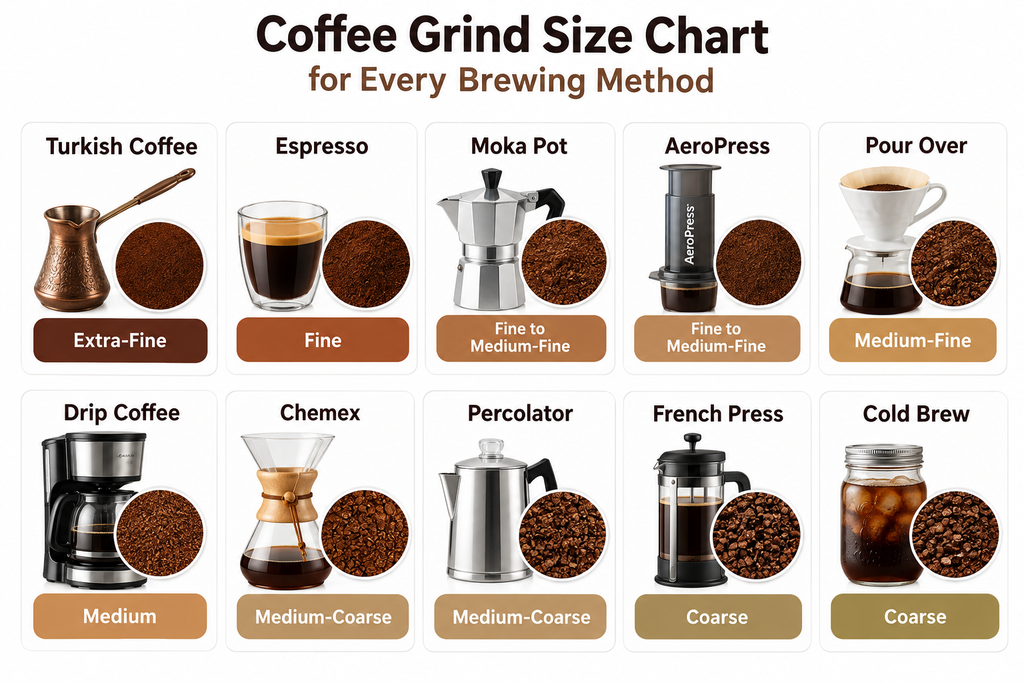
These recommendations are starting points rather than strict rules. You may need to make small adjustments depending on your coffee beans and equipment.
Extra-Fine Grind: Turkish Coffee & Other Methods
An extra-fine grind has a texture similar to flour or powdered sugar. It is most closely associated with Turkish coffee, where the grounds are traditionally brewed directly in the coffee without being filtered out.
Because the particles are extremely small, they extract quickly. This grind is generally not suitable for standard drip machines or French presses.
Best suited for:
- Turkish coffee
- Some traditional unfiltered coffee preparations
For Turkish coffee, consistency is particularly important because larger particles can noticeably change the texture of the finished drink.
Fine Grind: Espresso, Moka Pot & AeroPress
A fine grind resembles fine sand and is commonly used for espresso. Espresso machines force hot water through a compact coffee puck under pressure, so the smaller particles help provide enough resistance for proper extraction.
Moka Pot coffee can also work well with a fine or medium-fine grind, although it should generally not be ground as finely as espresso.
AeroPress is more flexible. Depending on the recipe, you can use anything from fine to medium-fine coffee.
Common uses:
- Espresso
- Moka Pot
- AeroPress
- Some concentrated coffee recipes
If espresso flows extremely quickly and tastes thin, a finer setting may help. If it takes too long and tastes harsh, a slightly coarser grind may be appropriate.
Medium-Fine Grind: Pour Over & Filter Coffee
Medium-fine coffee sits between fine and medium on the grind scale. It is often useful for pour-over brewing because it provides a balance between water flow and extraction.
The ideal setting can vary considerably depending on the dripper, filter, coffee dose, and pouring technique.
Common uses:
- Pour over
- Some AeroPress recipes
- Cone-style filter brewers
If water runs through the coffee bed too quickly, try grinding slightly finer. If the brew drains very slowly or tastes overly bitter, move slightly coarser.
Medium Grind: Drip Coffee & Automatic Brewers
A medium grind is one of the most versatile options for everyday coffee. It typically resembles regular sand and is commonly recommended for automatic drip coffee makers.
The particles are large enough to allow reasonable water flow while still providing sufficient surface area for extraction during a typical filter-coffee cycle.
Common uses:
- Automatic drip coffee makers
- Flat-bottom filter brewers
- Some pour-over methods
- Standard electric coffee makers
For most automatic drip machines, medium is a good starting point before making finer adjustments.
Medium-Coarse Grind: Chemex & Percolator Coffee
Medium-coarse grounds are larger than standard drip coffee grounds but smaller than typical French press grounds.
This size can work particularly well with Chemex brewing, where the thick paper filter and longer brewing process influence water flow.
It can also be useful for some percolators.
Best suited for:
- Chemex
- Percolator coffee
- Certain manual filter methods
If your Chemex coffee tastes weak and finishes brewing very quickly, a slightly finer grind may improve extraction. If it drains slowly and tastes bitter, try going coarser.
Coarse Grind: French Press & Cold Brew
A coarse grind consists of relatively large coffee particles. It is especially popular for brewing methods that involve longer contact between coffee and water.
French press coffee is a classic example. Coarser grounds can make it easier to separate the coffee from the water and may reduce the amount of fine sediment in the cup.
Cold brew also commonly uses coarse grounds because the coffee extracts over many hours.
Common uses:
- French press
- Cold brew
- Some percolators
- Long-steep brewing methods
For cold brew, the exact grind can depend on whether you use a concentrate recipe or a ready-to-drink ratio.
How to Adjust Your Coffee Grinder for Better Extraction

Choosing the correct grind size is only the first step. You may need to adjust your grinder after tasting the coffee.
Use the flavor and brewing behavior as clues:
- Sour or weak coffee: Try a slightly finer grind.
- Bitter or harsh coffee: Try a slightly coarser grind.
- Very fast brewing: A finer grind may slow the water flow.
- Very slow brewing: A coarser grind may improve the flow.
- Too much sediment: Try a coarser grind or a better-matched filter.
Make small adjustments rather than changing the grinder dramatically. A single change in grind size can affect brewing time and extraction noticeably.